Showing posts with label Clare Sansom. Show all posts

Monday, 26 August 2024

Bears and gold

Here are some poems that made it to publication in August 2024.

East Anglia bylines colleague Kate Moore drew my attention to the imminence of Poetry Bears' Picnic Day 2024. I responded with an article showcasing poems I had written at various times between 1985 and 2018 on the subject of bears. Some of them had featured in this blog already.

Allow me to present a couple that haven't.


BEARS


True, bears are solitary and not lovable.

True, I stopped buying teddy bears as the window sill filled up.

True, we did not meet the bears we saw in their sunken field at Whipsnade.

True, most bears live rather a long way away.

True, bears do not cater, and cycle only under duress.

True, 'The 59th bear' by Ted Hughes includes a cautionary tale.

True, Christopher Milne's story casts shadows on tales of Pooh.

True, Britain's way with foreigners, in 1958 and in 2018, adds to the implausibility of Paddington.

True, my childhood behaviour jars on my childhood identification with Rupert Bear.

True, confusion may arise from saying bear to mean lover, partner, or on that spectrum.

True, I wearied colleagues by the conceit.

BUT

It also remains true that Clare rhymes with bear.

I like this sort of bear.


'Bears' was written in 2018 as my response to prompt 26 in Jo Bell’s book 52: Write a poem a week. Start now. Keep going. The brief was actually for an erotic poem, but as chapter author, Neil Rollinson, went on to explain:

Let’s write an erotic poem that’s about other issues: illness, growing old, familial and domestic disappointment perhaps…Let something else carry the focus, or energy, and let the erotic take a back seat.

So, that’s what I did. The conceit in the final five lines explains the other poems presented here. I do not have a fetish about bears, but they supply a vocabulary. Clare, as most readers of this blog will know, is my wife, the lecturer and science writer Dr Clare Sansom.


CLARE CONTRASTED WITH A BEAR


Bears do not cook the food I eat;

bears have enormous claws on their feet;

bears dance to the pain of a metal beat.


Bears cannot bike, or teach, or write;

bearskin offers no gleam of barelight;

and an ursid bear would not incite

a poem to compete.


The idea of exploring the contrast between a bear in our sense of a lover, partner, or on that spectrum, as in the first poem, and a genuine ursid bear, came about after Clare suggested I enter a Valentine poetry competition, I think run by BBC Radio Three, in 2007.

If you read the article, you'll see that Clare herself contributed a recipe to it, for flapjack to feed to participants in such a party as was envisaged. From the golden brown of flapjack and most teddy-bears it's a short step to the gold of jubilees.

Ledbury Carnival celebrated its golden jubilee in August 2024, and Robin Fortune-Hiseman, who was responsible for designing and printing the programme booklet, asked if I had any poems about carnivals or gold that he could use. He wasn't commissioning a new poem, just asking me to search in my poetry back catalogue. I sent him this from 2012, which was written originally for the Keats-Shelley Memorial Competition and satisfies the requirement for gold if not  carnivals. 


BUS HOME FROM WORKING SUNDAY


A golden purchase:

honey cashews bought to draw

pound coins from a note,

with first-class stamps included

as if to be virtuous,


and tweets from the bus

about rules against working

Sunday and against

writing self-impositions.

Twitter's golden not guilty


for exploration

of the gold in little things,

gold found while thinking

of something else; grain harvest

by-product of the searched earth.


Some of you may discern a kinship, in the use of the 'gold' motif, between that piece and Robert Horan's poem 'The queen's face on the summery coin', known to me through Samuel Barber's setting. I believe my use of the motif is different enough for this not to be a matter of plagiarism.

Monday, 1 January 2024

Citizen science and citizen journalism

Believed,

the pensioner

enjoyed brief fame.

Someone had a video.

Doubt.


Busy, 

the traffic

kills many beasts.

Count those you see.

Understanding.


Disillusioned,

a land 

needs new stories.

Citizen journalism seeks them.

Maps.


Risky.

The firm 

pays its dividend.

Sewage taints its water.

Bacteria.


Thriving,

the company

pays huge bonuses.

But watch its sewers. 

Fines.


Wild,

the starlings

decline in numbers.

But they keep mimicking. 

Life.


The above things represent a form its inventors call Elfchen, from the German for 'eleven'. It's based on a pattern of words rather than of syllables, feet or rhymes. Eleven words, disposed as follows:

1 Word: An adjective

2 Words: A noun with an article

3 Words: An action of the noun

4 Words: Complement the action

1 Word: A noun that closes the story

This whole thing was the brainchild of the 'Storytelling and other arts' working group of the European Citizen Science Association (ECSA). I heard of the project from my scientist wife Clare.

The links in my Elfchen are to stories in East Anglia bylines, a citizen journalism outlet I've been involved with for a couple of years now. The linked stories are not mine, but I hope writing Elfchen about them gives me a vague sort of association with them.

The Elfchen were included by ECSA in their collection Citizen science through poetry, available both as A3 poster and as a foldable booklet. The plan is to share printed copies at the ECSA 2024 conference in Vienna, 3-6 April 2024.

Copied here with ECSA's blessing -- thanks. They ask that everyone use the hashtags

#PoemsForCitSci and #citizenscience

and tag

@eucitsci, when promoting their work on social media. Done!

Sunday, 10 April 2022

Three tree poems


Picture by Clare Sansom

HAVING BANANAS

Vexed by the appeal's

planting banana seeds line,
our botanist friend
would donate no cash that year.
Someone wrote to Christian Aid.

Wikipedia's
'Banana' discoveries,
rich like one per line:
seeds spiky, hard, cracking teeth,
genes too same, vulnerable,

nomenclature skein,
name-calling for republics,
handy for preaching,
sometimes hanged to make a point,
sometimes matter for fair trade.


SINCE KILMER

Since Kilmer knew he’d never see
a poem lovely as a tree,
and trees get felled, and poems penned,
why have a contest that will tend
to make the skew worse?    Bards, why bother
competing to compose another?
The answer is that words are good
for people who have missed the wood,
or seen the wood and missed the tree.
Maybe you see them both.    Not me.
Faced with a woodland scene, I need
programmes, subtitles I can read.   


TOUCHES OF EARTH

Earth-wild: a tangled query when she'd heard
of fennel children but not seen the word,
and wanted books from this fool who had read
assuming fear in how the word was said.

Earth-soiled: a soiled sheet brought Wilde down.  They cleanse
soil from carrots by acid.  Changing lens,
you see the carrots in their acid skin
endangering the eat of what's within.

Earth-rooted: what I mean by this is not
the waste of being rooted to the spot,
but roots to anchor, roots to store soil food,
roots you can almost hear grow in that wood,
holding the earth as deep as making height,
trees striving from it into air and light,
proud in a mode of growth those who know tell
plants came at independently and well,
neat, robust way through eco-stress.
I'll stop before I wish the trees success.

Earth-bound: not -using, as in house- or bed-;
serious earth, cue Larkin's many dead.
The end of all that rootedness and growing.
Let's call it homeward bound, but it's a going.

I read this set of three poems at an open-air event in Cambridge University's Botanic Garden.  This had originally come to my attention via my wife Clare, who'd seen an announcement on one of her science journalism email lists.  

'Having bananas' is new,  and was written specially for the event.  

'Since Kilmer' was written in 2004, for a competition celebrating the 90th anniversary of Joyce Kilmer's poem 'Trees'.  

'Touches of earth' was written in 2014 for the Keats-Shelley Memorial Association competition, whose theme that year was the Tennyson quotation "Who loves me must have a touch of earth".  Guinevere, in the Arthurian romance Lancelot and Elaine, is scorning Arthur's perfection.  But I made no reference to the original context in the poem.

'Since Kilmer' and 'Touches of earth' were previously published in the booklet for the 'Remarkable world of trees' exhibition at St Albans Museum.

The Botanic Gardens event was the brainchild of Anne Thomas, and others whose work featured there were Rosalind Moran, Ann Gray, and Matt Howard.  An illustrious company to find myself in!

Tuesday, 6 June 2017

A most welcome birthday present

Clare's present for my 60th birthday was to commission a musical setting of one of my poems from Kathryn Rose.  Clare pointed Kathryn in the direction of this Blurtmetry blog, and gave her a free hand in choosing.  The poem Kathryn picked was 'Apology' from 2010.

I blogged 'Apology' after Sue Butler kindly accepted it for her 'Walking with poets' blog at the Benmore Botanic Gardens near Edinburgh.  Thanks to Sue for encouragement in connection with the present post.

The song comes with a CC-BY-SA (Attribution-ShareAlike) Creative Commons licence.  You may photocopy it, share it, perform it, record it, do pretty well anything you like with it provided that

(i) you attribute its authorship correctly

(ii) you impose no copyright restrictions of your own on anything you make of it.

Here's the score.

And here's Kathryn's recording.

It was quite a thing, opening that on the day.


Sunday, 1 January 2017

Thing 16: Crowdsourcing and citizen science

Crowdsourcing

Georgina's post for this Thing has led me to re-familiarise myself with Kickstarter and Patreon, on both of which I have responded to appeals in recent years.  So far as I can tell, the main difference between the two sites is reflected in their names: Kickstarter enables contributions to get projects started, Patreon enables long-term support.  Composer Kathryn Rose has released some good music, and music in progress, via Patreon, and interesting accounts on her blog and Twitter stream about how the site impinges on the creative process and her business model.

I can see I'd do well to follow more on both sites.

"Do you have an idea for a project that could be crowdfunded?" asks the post.  Sorry, no.  I am intrigued to read the caveats from A Waterfall of Consciousness and Library Spiel about the risk that crowdfunded projects may repel friends and regular funders, especially noting that in Library Spiel's case this caveat is evidently based on experience.  Here's an idea that I did have at one time; it has now run out of steam, and crowdfunding is not sought.  I had better admit that my own kin never thought much of the project.

Citizen science

"What do you think about the democratisation of research and science through citizen science projects?"

It's probably a good idea.  Here's an article my science-journalist wife wrote about developments in this area some four years ago.  Note that the article doesn't present citizen science as an irreversible triumph: in 2013, chemistry was less keen on the idea.  Despite the successful application of citizen-science practice in some chemical research, the question was "Should chemistry join the gang?" and reservations were quoted from some chemists.  I don't know if it's significant that Zooniverse's current project list includes no reference to chemistry.

Related to both chemistry and citizen science is another movement drawn to my attention by Clare: that of the expert patient.  A flagship for this movement is Patientslikeme.  New research mentioned on this site on the day I write, 1 January 2017, includes developments in clinical trials, new ways of indicating levels of pain, and improvements in patients' self-management and self-efficacy.

The question uses the word 'democratisation'.  Democratisation is the benefit that citizen science confers.  Research abc writes that "Hopefully more people appreciating this process will increase public confidence in scientific statements."  

That's better than an unquestioning acceptance of what experts say.  And better than a generic distrust of experts.

I suppose citizen science stands up better against sociopaths and demagogues than those other states.  But I bet a determined troublemaker could spoil even citizen science.

Monday, 10 October 2016

Street collection

This was my entry in the competition for the 2017 desk diary published by Rhyme and Reason, a fundraising arm of Rennie Grove Hospice Care.  The theme was 'Magic and mystery'.  My contribution is based, with minimal poetic licence, on an encounter my wife Clare had while collecting house-to-house for the charity Christian Aid.


STREET COLLECTION

The street's sunny side --
evens – housed one who opened
an odd-side door.
His reason for not giving
was his distrust of money.

His volunteer work
had ended when volunteers
fundraising called him.
"Data protection", I said.
He'd fit a children's story:

all those oddities, 
and he had a Gandalf beard.
Would you like to try?
Neither copyright nor -left
stops your riffs on an idea.

Money from the street
a magically large sum?
Something's redemption?
His peace with those volunteers?
I don't write for kids myself....


As in previous years, my poem won no prizes, but was among those published in the diary. £5 via this link.

Monday, 21 March 2016

Clare and the allness of all things


CLARE AND THE ALLNESS OF ALL THINGS

O little rondure, swimming at the gym,
your husband's not Walt Whitman so this image pleases him.


That couplet was written in 2001, taking its cue from Walt Whitman's 'The explorers' -- one of several Whitman poems set by Ralph Vaughan Williams in his Sea symphony.  My couplet's only claim to publication before this blog post is that I tweeted it on Sunday 20 March 2016.  I was led to do so partly by the fact that the Cambridge Philharmonic Society, in which I sing tenor, is preparing a performance of the Sea symphony, as it was when I wrote the poem.  Part of the score cover appears in the photograph above.

Clare, as many readers of the blog may know, is my wife Dr Clare Sansom.  The brooch in the picture is by Jane Bower, another Cambridge Philharmonic singer, and was made to commission as my valentine to Clare in 2002.

"The allness of all things" is my phrase for one of Whitman's favourite themes.  A classic instance is another Whitman poem in the Sea symphony, 'On the beach at night alone'.  In some moods one might say that the theme is instantly self-exhausting, but Vaughan Williams' setting of Whitman's texts, here and elsewhere, is very fine.

The Cambridge Phil's performance of the Sea symphony will be at 19:30 on Saturday 9 July in Ely Cathedral. 


Saturday, 23 May 2015

Marc Vyvyan-Jones

This is my wife Clare in 1985:

Clare in those days was a physics PhD student at Bristol.  The image is from a new-address card she commissioned from a friend, and it came to light again, many years later, in a clear-out of Clare's room at her parents' house.

The writing embroidered on Clare's leg reads "Please look after this Clare."  That drew from me a limerick, 11 years before we were engaged:

I'd love to look after this Clare,
blonde and plump like a girl teddy-bear.
I just hope that her rump's
not too bruised by the bumps
which arise from the wheels' being square.

The teddy-bear in Clare's lap had been a birthday present from friends, a couple of years earlier.  She believes she passed it on to a child in 1990, when she had to shed so many possessions for her post-doc year in the States, and she cannot now remember its name.

For those too young to have seen floppy disks, I'd better say that they were at least as square as shown in the picture, and not the sort of Daliesque thing the name suggests.  The title of Dali's painting The persistence of memory has acquired a secondary aptness from the transience of floppies.

The artist was Marc Vyvyan-Jones.  It was his first commission, he told me recently; billed then on invoice 0001, and reproduced now with permission.  His career as an illustrator continues to thrive, with an emphasis on the quirky and gallimaufrageous.  Who's next up to offer him a commission?

Thursday, 15 August 2013

For Clare


The librarian's bear is an articulate bear.
The librarian's bear is a biophysicist bear.
The librarian's bear is a Christian bear.
The librarian's bear is a dancing bear.
The librarian's bear is an eager bear.
The librarian's bear is a female bear.
The librarian's bear is a Guardian-reading bear.
The librarian's bear is a happy bear.
The librarian's bear is an intellectual bear.
The librarian's bear is a journalistic bear.
The librarian's bear is a knowledgeable bear.
The librarian's bear is a little bear.
The librarian's bear is a massaging bear.
The librarian's bear is a nominally plump bear.
The librarian's bear is an optimistic bear.
The librarian's bear is a popular bear.
The librarian's bear is a questioning bear.
The librarian's bear is a round bear.
The librarian's bear is a solid bear.
The librarian's bear is a trustworthy bear.
The librarian's bear is an uncommon bear.
The librarian's bear is a valuable bear.
The librarian's bear is a web-whizzkid bear.
The librarian's bear is an extrovert bear.
The librarian's bear is a young bear.
The librarian's bear is a zestful bear.


The above lines were written in 1998, the year Clare and I married, and were published in Streetwise 32, autumn 1998, p. 18.  I should say that I was editor of Streetwise at that time.  I am posting them on the eve of our 15th anniversary.

Strictly speaking, Clare is not much like a bear, and has never been seriously plump.  However, when we met in 1982, she was less slight than the woman I had been told she resembled, and 'plump' is a word I like the sound of.  I draw on that first plump impression for a continuing licence to say it.

Clare is the first person to see my poems and comment on them, and they sometimes reflect her work in science journalism.


Monday, 15 August 2011

Cam23 2.0: Week 9, extra thing: Creative Commons

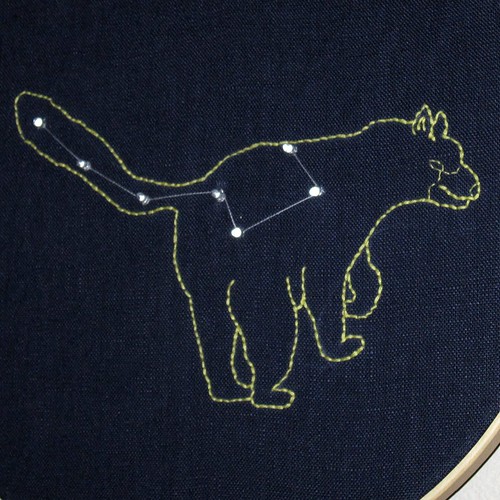
Detail of Ursa Minor embroidery by Shannon Henry, on Flickr
Creative Commons Attribution-Noncommercial-Share Alike 2.0 Generic License by Shannon Henry

This week's extra thing is one I've wanted to read ever since last year's introduction to Creative Commons licences: how to reproduce a Creative Commons image with its licence attached. Now I know. Call me lazy, if you like, for waiting this long, and not racing Facebook and Twitter for the information; but now I've got it I'm going to use it. See the above picture.

My first use of Creative Commons in this way is dedicated, without permission, to Clare on our 13th wedding anniversary. Watch out for Haddon-Library-related images on the Haddon Library website before long.

I expect that I will sooner or later be sticking CC licences on poems of mine when I blog them. However, I can see that that will need caution. I don't blog poems of mine that haven't been already published somewhere. I consult the publishers about this by email. If I'm going to start sticking licences on the poems then presumably such emails need to contain a bit more than "I'm blogging xxx, which you printed in 2004. Hope that's OK."

I will wait a bit before trying that experiment.